How Can Preschool Help Children Develop Independence Before Starting School?
Starting school is a major milestone in a child’s life. Along with learning letters, numbers, colours, and new concepts, children also need to become comfortable doing small things on their own. Getting dressed, eating independently, keeping belongings in the right place, following simple routines, asking for help, and interacting with other children are all important parts of school readiness.
For parents, preparing a child for school is not only about buying school supplies or practising the alphabet. Building independence gradually can help children feel more confident when they enter a new environment. Early Buds Preschool focuses on creating an environment where children can learn through everyday experiences while developing age-appropriate independence and confidence.
Why Is Independence Important Before School?
Independence does not mean expecting a young child to manage everything without support. It means giving children appropriate opportunities to try, practise, make simple choices, and complete manageable tasks with guidance.
When children are encouraged to do things for themselves, they begin to understand that their actions can make a difference. Completing a small task, such as putting away a toy or carrying their own bag, can create a sense of achievement.
These experiences can also support confidence, decision making, responsibility, problem-solving, and self-help skills for preschoolers. The American Academy of Pediatrics also recommends giving young children opportunities to take responsibility for simple household tasks and practise activities such as dressing themselves.
What Self-Help Skills Should Children Learn?
Self help skills are everyday abilities that allow children to take care of simple personal needs. These skills develop gradually and differ from child to child.
Before starting school, parents and educators can encourage children to practise:
- Eating and drinking with age-appropriate utensils
- Washing and drying hands
- Using the toilet with appropriate support
- Putting on and removing simple clothing
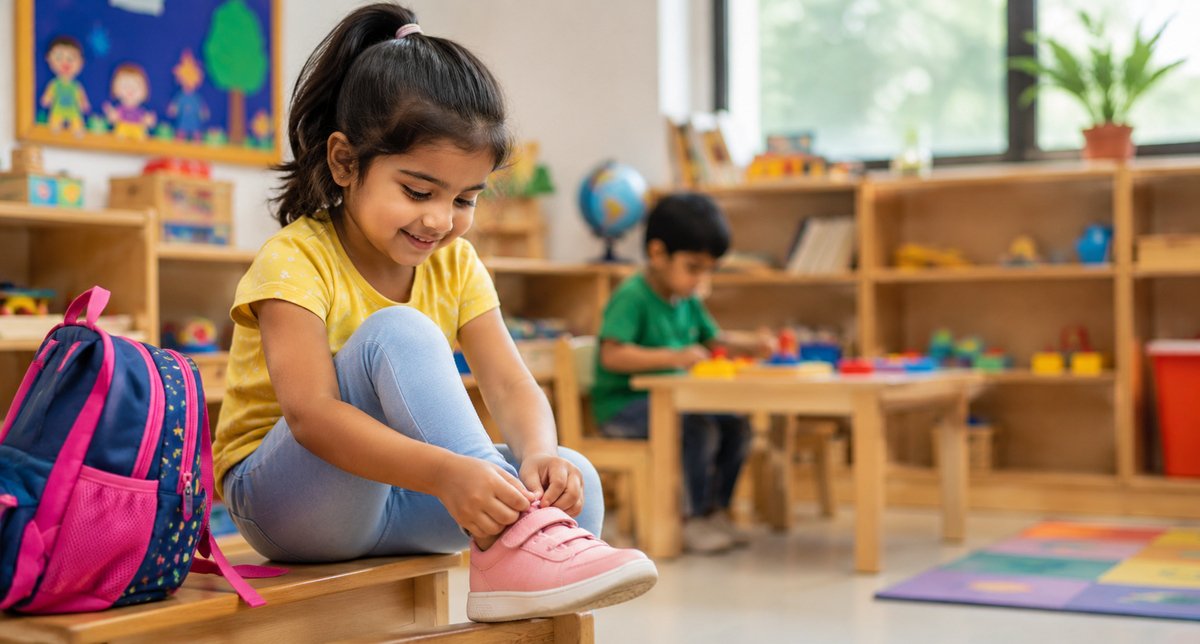
- Wearing shoes and managing easy fastenings
- Packing or carrying their school bag
- Keeping toys and learning materials in their place
- Opening simple food containers
- Asking for help when something is difficult
- Following simple instructions and routines
Children do not need to perform every task perfectly before entering school. The goal is to provide regular opportunities to practise and become increasingly comfortable with everyday responsibilities.
How Does Preschool Build Independence?
A good preschool environment gives children opportunities to make choices and participate in daily routines. Instead of adults completing every task for children, educators can guide them through age appropriate activities. For example, a child may be encouraged to choose between two activities, put away materials after play, carry their belongings, or participate in classroom routines. Such simple experiences can become meaningful learning opportunities.
Children also learn by observing others. When they see teachers and classmates following routines, sharing materials, cleaning up, and communicating respectfully, they gradually understand how to participate in a group environment. This makes preschool readiness more than academic preparation. It includes social, emotional, physical, and practical skills that help children feel comfortable in a school setting.
How Can Parents Encourage Independence at Home?
Parents can support independence in children through ordinary household routines. There is no need to create complicated activities. Everyday moments can become opportunities for learning.
A child can be encouraged to put toys back after playing, place dirty clothes in a basket, carry a lightweight item, help set the table, or choose between two suitable outfits.
The CDC recommends giving preschool-aged children opportunities to help with simple chores because these activities can support independence.
Parents can also use simple language such as:
“Would you like the blue cup or the green cup?”
“Can you put your shoes near the door?”
“What do you think we should do first?”
These questions give children opportunities to make simple decisions while remaining within safe boundaries.
Can Daily Routines Make Children More Independent?
Yes. Consistent routines can make everyday activities easier for young children because they know what is likely to happen next. A simple morning routine might include waking up, using the bathroom, getting dressed, eating breakfast, brushing teeth, and preparing the school bag.
At first, parents may need to guide the child through each step. Over time, children can begin completing some steps with fewer reminders. The American Academy of Pediatrics notes that predictable routines and responsibilities can help young children understand what to expect during the day.
The same approach can be used in a daycare or preschool environment. Consistent routines around meals, play, clean-up, rest, and transitions can help children become familiar with expectations.
How Does Independence Build Confidence?
A child who successfully completes a task can experience a sense of accomplishment. Even a small achievement can encourage the child to try something new. For example, a child who learns to put on their shoes may feel proud of being able to prepare for outdoor play. A child who learns to clean up after an activity may begin to understand responsibility.
Adults should focus on the child’s effort rather than expecting perfection. If the shirt is slightly backwards or the toys are not perfectly arranged, allowing the child to finish the task can sometimes be more valuable than immediately correcting it.
What Role Does Early Childhood Education Play?
Early childhood education provides children with opportunities to learn through play, interaction, routines, and guided experiences. It can complement what children learn at home by giving them opportunities to practise skills in a group setting. Children may learn to wait for their turn, share materials, follow instructions, communicate their needs, solve small problems, and participate in classroom routines.
These experiences are particularly useful because school involves many situations where children need to manage small responsibilities while interacting with others. A quality early learning environment does not rush children into independence. Instead, educators provide support when needed and gradually encourage children to try things independently.
How Can Play Support School Readiness?
Play is an important part of early learning. Through pretend play, building activities, art, puzzles, outdoor activities, and social games, children can practise different skills without feeling that they are completing a formal lesson.
Pretend play can be especially useful for preparing children for unfamiliar situations. Parents and educators can play “going to school” games where children practise carrying a bag, greeting a teacher, sitting with classmates, asking for help, or saying goodbye to a parent.
Should Parents Help or Let Children Try?
Finding the right balance is important. Children still need adult support, especially when a task involves safety or a skill they have not yet learned. However, immediately stepping in whenever a child struggles can reduce opportunities to practise.
A useful approach is to show, guide, and gradually step back. For example, when teaching a child to pack a bag, a parent can first demonstrate the process. Next time, the child can try while the parent gives verbal reminders. Eventually, the child may be able to complete most of the routine independently. This approach allows children to experience support without becoming completely dependent on adults.
What If a Child Takes Too Long?
Young children often need more time to complete everyday tasks. Getting dressed independently may take longer than when an adult does it. Cleaning up toys may also take extra time. Instead of rushing every task, parents can build a little extra time into the routine. Giving children enough time to practise can make independence feel achievable rather than stressful.
It is also helpful to focus on one skill at a time. If getting ready for school feels overwhelming, start with something simple, such as putting shoes in the correct place or placing toys back on a shelf. Gradual progress is more important than doing everything at once.
How Does a Preschool in Bangalore Support Independence?
For families looking for a preschool in Bangalore, independence can be an important factor to consider when evaluating an early learning environment. Parents can look for a preschool where children receive opportunities to participate in routines, interact with peers, explore activities, communicate with educators, and take responsibility for age-appropriate tasks.
A supportive environment should allow children to learn at their own pace while providing appropriate guidance and encouragement.
At Early Buds Preschool, everyday learning can be viewed as an opportunity to help children become more confident, capable, and comfortable in a group setting. The focus is not simply on completing tasks but on helping children develop skills that can support their transition into formal schooling.
How Can Parents Make the Transition Easier?
Preparing children for school can begin several weeks or months before the first day. Small changes to the home routine can make the transition smoother.
Parents can practise:
- Following a predictable morning routine so the child knows what happens next.
- Managing simple belongings such as shoes, bags, bottles, and toys.
- Communicating needs clearly, including asking for help.
- Following two- or three-step instructions appropriate to the child’s age.
- Playing with other children to practise sharing and taking turns.
- Trying small responsibilities at home.
- Talking positively about school without creating unrealistic expectations.
What Are the Signs of Growing Independence?
Every child develops at a different pace, so independence should not be treated as a competition. Some children may quickly attempt new tasks, while others may need more encouragement.
Signs of growing independence can include:
- Trying a task before asking an adult to do it
- Making simple choices
- Helping with household or classroom routines
- Taking care of personal belongings
- Asking questions when unsure
- Attempting to solve small problems
- Communicating needs and feelings
- Showing pride after completing a task
These behaviours can gradually contribute to school readiness and a child’s confidence in unfamiliar environments.
Conclusion
Helping children develop independence before starting school is a gradual process built through everyday experiences. Simple activities such as getting dressed, putting away toys, making small choices, following routines, and asking for help can become valuable opportunities for early childhood education and personal development.
Parents do not need to expect perfection. Children need patience, encouragement, consistent routines, and opportunities to try. A nurturing preschool can reinforce these experiences by creating an environment where children can explore, interact, practise self-help skills, and develop confidence.
For parents searching for a preschool in Bangalore, Early Buds Preschool provides an early learning environment where children’s development can extend beyond academics. By encouraging age-appropriate independence alongside social, emotional, and learning skills, Early Buds Preschool helps children take confident steps toward their next stage of education.
Frequently Asked Questions
At what age should children start learning independence?
Children can begin developing age-appropriate independence from a very young age. Simple activities such as helping with dressing, putting away toys, choosing between two options, and helping with household routines can be introduced gradually. Expectations should always match the child's age and abilities.
How can I prepare my child for school at home?
Create predictable routines and encourage your child to practise self-care, communication, simple decision-making, and responsibility. Let the child attempt manageable tasks before stepping in to help.
What skills should a child have before starting preschool?
Children benefit from practising basic self-care, following simple instructions, communicating their needs, interacting with others, managing simple belongings, and participating in routines. Academic skills are only one part of being ready for preschool.
Does daycare help children become independent?
A quality daycare environment can give children opportunities to follow routines, interact with peers, practise self-help skills, and participate in age-appropriate responsibilities. Consistency between home and daycare can further support these skills.
What if my child still needs help with basic tasks?
Needing help is normal. Independence develops gradually, and children should not be pressured to master every skill at the same time. Parents and educators can identify manageable tasks, provide guidance, and gradually reduce support as the child becomes more confident.