Academic Readiness and Problem-Solving Skills for Little Learners
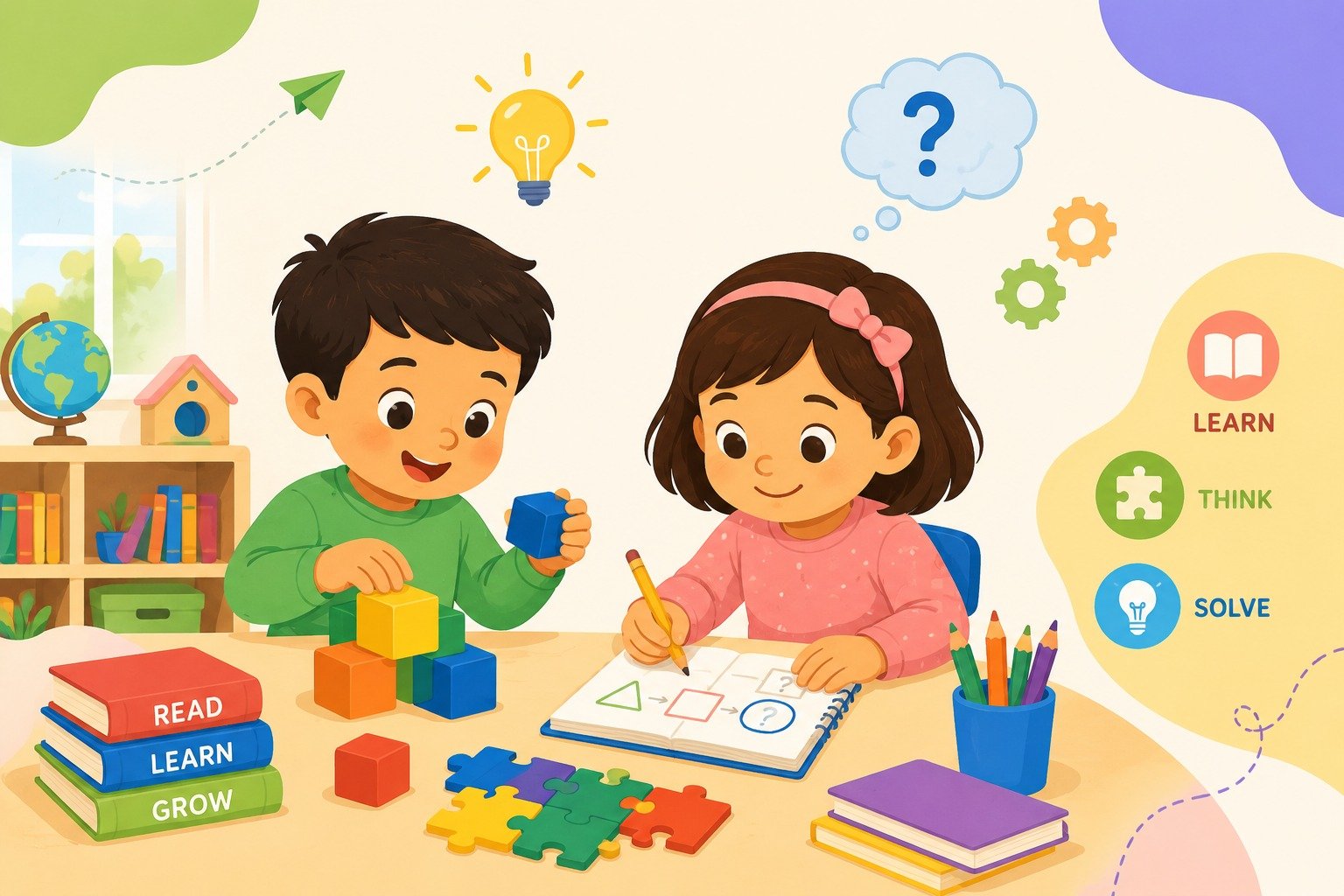
Starting school is an exciting milestone for every child, but academic readiness is about much more than knowing letters, numbers, or how to write their name. A child who can listen, ask questions, follow simple instructions, make choices, and find solutions to everyday challenges is developing important skills for a successful learning journey.
For young children, these abilities grow naturally through play, conversations, exploration, hands-on activities, and supportive interactions. Early Buds Preschool understands that children learn best when they are encouraged to explore ideas rather than simply memorize information.
One of the most valuable parts of school readiness is developing problem-solving skills for kids. When children learn how to think about a challenge, try different approaches, and learn from mistakes, they become more confident and independent learners.
What Is Academic Readiness?
Academic readiness for preschoolers refers to the collection of skills children gradually develop before entering formal schooling. These skills help children participate comfortably in a classroom, understand instructions, communicate their needs, and engage with learning activities. Academic readiness does not mean expecting preschoolers to behave like primary school students. Instead, it involves building a strong foundation for future learning.
Some important school readiness skills include:
- Listening and understanding simple instructions
- Recognising basic letters, numbers, shapes, and colours
- Developing early language and communication skills
- Paying attention to an activity for an age-appropriate period
- Asking questions and expressing ideas
- Developing fine and gross motor skills
- Working and playing with other children
- Managing simple emotions and frustrations
- Making choices and solving simple problems
These abilities work together. A child who develops confidence in one area may also become more comfortable exploring another.
Why Does Problem-Solving Matter?
Children encounter small problems throughout the day. A toy may be out of reach, a block tower may fall, a puzzle piece may not fit, or two children may want the same toy. Instead of immediately solving every problem for a child, adults can give children opportunities to think about possible solutions. This is where problem-solving for children becomes an important part of early learning. Children begin to understand that a problem can have more than one solution and that making a mistake does not mean they have failed.
For example, if a child is building a tower and it keeps falling, an adult could ask:
“What could we change to make the tower stronger?”
This simple question encourages the child to observe, think, experiment, and try again. Such experiences gradually develop critical thinking for kids and encourage children to become active participants in their own learning.
How Does Preschool Build Problem-Solving Skills?
A thoughtfully designed preschool environment gives children regular opportunities to explore challenges in meaningful ways. Rather than treating learning as only worksheets and memorisation, preschool problem-solving activities can be included in everyday classroom experiences.
Through puzzles and matching games
Puzzles encourage children to observe shapes, remember information, compare possibilities, and make decisions. When a piece does not fit, children have an opportunity to try another position rather than immediately asking an adult for the answer.
Through building activities
Blocks, construction toys, and other building materials provide simple opportunities for experimentation. Children may discover that a tall structure becomes unstable or that a wider base makes a building stronger. These activities introduce early concepts of planning, balance, cause and effect, and spatial awareness.
Through stories
Stories are another powerful way to develop problem-solving skills for kids. When a character faces a challenge, teachers can ask children what they think the character should do next.
Questions such as:
- “What could the character try?”
- “Why did that happen?”
- “What would you do?”
- “Could there be another solution?”
encourage children to think beyond the obvious answer.
Through pretend play
Pretend play gives children opportunities to solve social and practical problems. A child pretending to run a shop may need to decide what to sell. Children playing house may decide who will perform different roles. During pretend travel, they may have to work out where they are going. These situations encourage communication, decision-making, imagination, and flexible thinking.
Can Play Improve Academic Readiness?
Yes. Play can provide a meaningful foundation for academic readiness for preschoolers when children are given opportunities to explore, communicate, make decisions, and solve age-appropriate challenges. Children do not need to sit at a desk for hours to develop useful learning skills. During a game, a child may be practising memory, following rules, counting, listening, taking turns, and adapting to changes.
The Center on the Developing Child at Harvard University notes that playful activities can help children practise executive function skills, including attention, working memory, and self-control. This is why purposeful play has an important role in early childhood education.
What Skills Support School Readiness?
Academic readiness involves several connected areas rather than one particular skill.
Language and communication
Children need to understand questions, communicate their thoughts, listen to others, and express when they need help. Reading stories together, discussing pictures, singing songs, and encouraging conversations can strengthen these abilities.
Early mathematics
Counting objects, sorting toys, comparing sizes, identifying patterns, and recognising shapes can introduce early mathematical thinking. For example, asking a child to sort buttons according to colour or size turns an everyday activity into a simple learning experience.
Attention and memory
Children gradually learn to listen, remember instructions, and complete simple tasks. Games such as “Simon Says,” matching games, memory cards, and action songs can provide enjoyable ways to practise these abilities.
Social-emotional skills
Children also need to learn how to cooperate, wait for their turn, handle small disappointments, and communicate with peers. These abilities can make classroom participation easier and help children feel more comfortable in group settings.
Motor skills
Holding crayons, turning pages, using scissors, drawing, stacking blocks, and manipulating small objects help develop fine motor control that supports future classroom tasks.
How Can Parents Develop Problem-Solving Skills?
Parents do not need expensive educational materials to support problem-solving for children. Everyday situations can become learning opportunities. Instead of immediately giving an answer, parents can pause and encourage the child to think.
For example, if a child cannot find a favourite toy, ask, “Where did you use it last?” or “Where could we look first?”
If a child struggles to complete a puzzle, encourage them to look at the colours, shapes, or edges before providing help. The goal is not to make every activity difficult. The goal is to give children enough support to experience the satisfaction of finding a solution.
Try these simple activities at home:
- Let children help decide how to organise their toys.
- Ask them to find different ways to build a block tower.
- Give them simple household sorting tasks.
- Encourage them to complete age-appropriate puzzles.
- Ask “What do you think will happen?” before an experiment or story ending.
- Let children help plan a simple snack or activity.
- Encourage them to try again when something does not work.
Why Should Adults Avoid Solving Every Problem?
It can be tempting to help immediately when a child struggles. However, doing everything for a child can reduce opportunities to practise independent thinking. This does not mean children should be left alone with difficult tasks. Instead, adults can provide scaffolding, just enough guidance to help children move forward.
For example, rather than saying, “Put the red piece here,” an adult could ask, “Which piece do you think might fit?”
This small change allows the child to remain involved in the thinking process. Over time, children can become more comfortable with trying, adjusting, and trying again.
How Do Teachers Encourage Critical Thinking?
Teachers can develop critical thinking for kids by asking open-ended questions and allowing children to explain their ideas. Instead of focusing only on whether an answer is correct, teachers can also ask children how they reached that answer.
Questions such as “How did you find that out?”, “What could you try next?”, and “Is there another way?” encourage children to explain their thinking. This approach can make classroom learning more interactive while helping children develop confidence in their own ideas.
What Are Easy Problem-Solving Activities?
Parents and teachers can introduce many simple activities to improve problem-solving skills in children.
A few age-appropriate examples include:
Mystery bag: Place familiar objects in a bag and allow children to identify them using touch and clues.
Building challenge: Ask children to build a bridge or tower using blocks and see how they can make it stronger.
Pattern games: Create simple patterns with colours, shapes, or objects and ask children what comes next.
Picture sequencing: Give children pictures from a familiar story and ask them to arrange them in the correct order.
Treasure hunt: Give children simple clues that require them to observe their surroundings and decide where to look next.
Everyday challenges: Ask questions such as, “How can we carry these toys without dropping them?” and let children suggest solutions.
The activity itself does not have to be complicated. What matters is giving children time to think, experiment, and communicate.
How Can Parents Know Their Child Is Becoming Ready?
Every child develops at a different pace, so school readiness should not be treated as a competition. Parents can look for gradual progress rather than expecting perfection. A child may begin asking more questions, staying with a puzzle for longer, following two-step instructions, explaining ideas, or trying another approach when the first one does not work.
These small changes can indicate growing learning skills for preschoolers. A supportive preschool can also work together with parents to understand a child’s interests, strengths, and areas where additional encouragement may be useful.
What Is the Role of Early Childhood Education?
Quality early childhood education provides children with opportunities to learn through relationships, play, exploration, language, and hands on experiences. Academic readiness should not be separated from social, emotional, physical, and cognitive development. These areas influence one another.
A child who feels secure and confident may be more willing to ask questions. A child who can communicate may find it easier to participate in group activities. A child who learns to manage frustration may be more willing to try a difficult puzzle again. This holistic approach helps create a stronger foundation for future learning.
Conclusion
Academic readiness is not about how many worksheets a child can complete before starting school. It is about developing the confidence, curiosity, communication, independence, and thinking skills that help children approach learning positively.
When children are encouraged to ask questions, experiment with ideas, solve small problems, and learn from mistakes, they gradually become more confident learners. Problem-solving skills for kids therefore form an important part of school readiness and early childhood development.
At Early Buds Preschool, meaningful learning experiences can help little learners develop the foundation they need for their next educational stage. With the right balance of play, exploration, interaction, and age-appropriate learning, children can begin their school journey with curiosity, confidence, and a willingness to learn.
Frequently Asked Questions
What is academic readiness for preschoolers?
Academic readiness refers to the early skills that help children participate comfortably in formal learning. These include communication, attention, early literacy and numeracy, motor development, social skills, independence, and problem-solving.
How can I improve my child's problem-solving skills?
Give your child regular opportunities to make choices, explore, build, sort, play games, complete puzzles, and solve simple everyday challenges. Ask guiding questions instead of immediately providing the answer.
Why are problem-solving skills important in early childhood?
Problem-solving helps children learn to think independently, make decisions, handle challenges, adjust their approach, and learn from mistakes. These abilities support classroom learning and everyday life.
Does play help children prepare for school?
Yes. Purposeful play can help children practise communication, attention, memory, self-control, cooperation, planning, and flexible thinking. These skills contribute to school readiness.
What are good preschool problem-solving activities?
Puzzles, building challenges, sorting games, sequencing activities, pretend play, simple treasure hunts, pattern games, and open-ended art or construction activities can encourage problem-solving.